Trends
Living dossiers — tracked, scored, editorially reviewed — with the momentum picture behind them.
Trend Dossiers
Every published trend, ranked by pulse score
 K962L / Wikimedia Commons (CC BY-SA 4.0)
Indigenous Futurisms
Contemporary Indigenous artists claiming speculative and science-fiction frameworks. From Sydney Biennale to the Whitney, Indigenous artists are mapping futures, not just recovering pasts.
 Gabriel Fernandes from São Paulo, Brasil / Wikimedia Commons (CC BY-SA 2.0)
Feminist Art Reclamation
A quiet but accelerating restoration of suppressed or overshadowed women artists is visible across multiple registers. Jacqueline Lamba, the Surrealist painter long eclipsed by her husband André Breton, is reclaimed through a new book revealing her love affair with Frida Kahlo — two marginalized-by-proximity women suddenly centered in the same story. Tate Modern's presentation of Ana Mendieta receives major critical attention. Shahrnush Parsipur's death at 80 prompts a renewed reckoning with how Iranian feminist defiance survives through artistic transmission. Yvonne Rainer's Trio A performs publicly at Tate Modern on its 60th anniversary, received as a live argument for the radical durability of feminist performance.
 Alisdare Hickson from Canterbury, United Kingdom / Wikimedia Commons (CC BY-SA 2.0)
Grief as Public Form
Across Venice, London, and the broader biennial circuit, artists are transforming grief into politically charged public spectacle. Gabrielle Goliath's 'Elegy' at Venice — staging a grieving of Palestinian lives after a shocking cancellation — and the 'Flare-Up' group show at Goldsmiths CCA (including Benoît Piéron, Carolyn Lazard, Felix Gonzalez-Torres) position mourning not as private emotion but as collective political demand. This differs from Care Aesthetics in its urgency: grief here is weaponized, not soothed.
 jonCates / Wikimedia Commons (CC BY-SA 4.0)
Post-Digital Painting
Painting that acknowledges and incorporates digital visual culture — from AirDrop aesthetics to phone-first composition.
 Peter Bellerby / Wikimedia Commons (CC BY-SA 3.0)
Diasporic Reckonings
Art practices exploring migration, displacement, and layered diaspora identities. Reshaping national pavilions at Venice.
 Francesco Pierantoni from Bologna, Italy / Wikimedia Commons (CC BY 2.0)
Body as Political Archive
A cluster of practices is treating the body — tattooed, photographed, sculpted, or dressed — as the primary site of political and historical inscription. Noore Yazigi's Arabic-script tattoo practice in New York draws directly from the Quran and the poetry of Palestinian writer Refaat Alareer, making skin a literal archive of resistance. Sabelo Mlangeni's James Barnor Prize-winning photography embeds itself in queer and rural South African communities, producing images that arise from deep social proximity rather than documentary distance. Ramingining's inaugural Aboriginal fashion week in East Arnhem Land stages Yolŋu culture and design as living embodied knowledge.
 Vcarceler / Wikimedia Commons (CC BY-SA 4.0)
Archive Grief AI
Mohamed Bourouissa's project 'Pour Noubia,' profiled in Mousse Magazine, traces the life of his late aunt across fragmented archives using AI as an instrument of personal mourning — a practice that fuses grief, diasporic memory, and machine learning into a new documentary mode. This sits alongside broader signals of artists turning to personal and collective archives as a response to loss, from Shahrnush Parsipur's death prompting reflection on how Iranian defiance is preserved through artistic transmission, to the Beuys conservation show in Ghent confronting what it means to keep a perishable art history alive.
 Matthew.kowal / Wikimedia Commons (CC BY-SA 4.0)
Eco-Materialism
Art practices centered on ecological crisis, material provenance, and the extraction-to-object chain. Artists trace the political life of materials from mine to museum.
 Hassan Hamdy wahidy / Wikimedia Commons (Public domain)
Immersive Export
Experiential art brands and installation-driven shows are being packaged and exported as cultural infrastructure — from Superblue’s first project at NMACC in Mumbai to large-scale installation commissions and fair programming in Seoul. The model pairs spectacle with new venue partnerships in growth markets.
 John Miller / Wikimedia Commons (CC0)
Protest as Biennale Format
The Art Not Genocide Alliance's planned protest to coincide with the US Ambassador's visit to Venice — paired with ongoing World Cup-era activist sculpture at LACMA by Lyndon J. Barrois Sr. and artists' memorials to Lorenzo Salgado Araujo, a Houston man killed by ICE — suggests protest is no longer counterpoint to the biennial circuit but is becoming structurally embedded within it. Venice 2026 is not just an exhibition — it is a site of contested geopolitical representation, with allied art worker coalitions treating the vernissage as a political stage.
 Samuel Zeller samuelzeller / Wikimedia Commons (CC0)
Amnesia as Medium
A cluster of research-based and oceanic-studies-aligned practices are turning the deliberate manufacture of collective forgetting into an artistic subject and formal strategy. ArtReview's profile of Shaunak Mahbubani's framework frames 'oceanic studies' explicitly as a lens for addressing 'the manufacture of collective amnesia' alongside environmental plunder and war. This sits beside the Beuys conservation show in Ghent, which confronts what it means to preserve a perishable art history before it disappears, and postwar Midwest Magic Realist revivals at the Milwaukee Art Museum that surface collaborative histories buried beneath mid-century canonical narratives. The Hudson River School's apocalyptic visions are re-read through a climate-crisis lens, as if landscape painting itself encoded a warning now being decoded too late.
 Ed Schipul from Houston, TX, US / Wikimedia Commons (CC BY-SA 2.0)
Institutional Critique Resurgence
Curators and institutions are re-examining the practices of institutional critique through renewed surveys and retrospectives — most visibly in Michael Asher’s MOCA Los Angeles survey and critical reassessments in major outlets. The discourse is shifting from historical canonization to practical retooling of museum operations.
 Raimond Spekking / Wikimedia Commons (CC BY-SA 4.0)
Archive as Repair
Artists and institutions are treating archives and recovered works as sites of restitution and civic repair. Coverage ranges from the slow uncovering and restoration of Julio Escámez’s murals to MFA shows that rework history’s debris into new narratives.
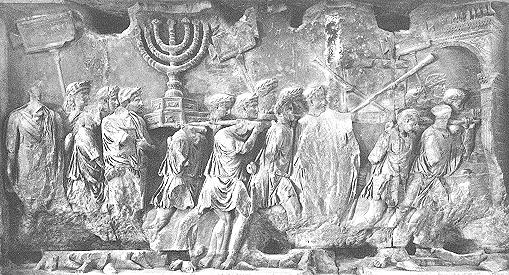 Editorial collection
Repatriation Accelerating
The pace and scale of repatriation has reached a new operational tempo. New York investigators returned 59 looted antiquities to Italy, Iraq, and Indonesia — 45 seized directly from the Metropolitan Museum of Art. The Netherlands and Germany jointly announced the return of 2,000 artifacts to Ghana. Italy is advancing new legislation specifically targeting Nazi-looted art restitution. The American Museum of Natural History is adding Native American hair clippings to its repatriation list. These are no longer isolated gestures — they are systemic shifts in how Western institutions account for their colonial acquisitions.
 Perimeander / Wikimedia Commons (CC BY-SA 4.0)
Museum Under Siege
A cascade of signals points to North American cultural institutions operating under unprecedented political and legal pressure. The White House has launched a public critique of the Smithsonian Institution's scholarship, Smithsonian Secretary Lonnie Bunch has been forced to publicly defend his institution's integrity, the Kennedy Center naming dispute is winding through federal appeals courts, and the New Museum is navigating a leadership reset with Massimiliano Gioni's appointment amid this turbulent climate. The Guggenheim, meanwhile, faces a literal health investigation over Legionnaires' bacteria in its cooling tower — a darkly apt metaphor.
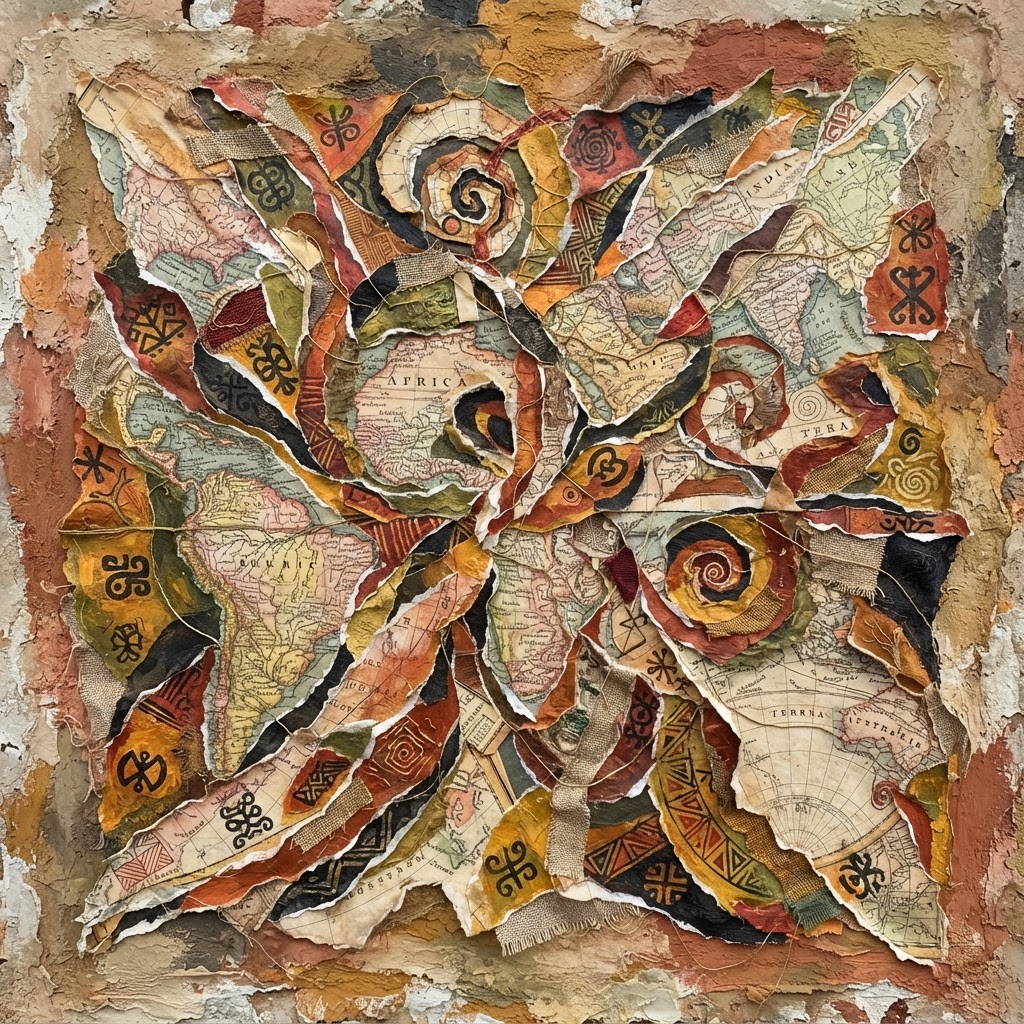 Editorial collection
Decolonial Practice
Institutional reckoning with colonial legacies in museums, collections, and exhibition-making. Encompasses restitution debates and non-Western epistemologies entering the mainstream.
 Vyacheslav Argenberg / Wikimedia Commons (CC BY 4.0)
Sacred Return
Spirituality is staging a serious comeback in critical art discourse, and it's not nostalgic. Spike Art Magazine devoted its 88th issue entirely to the theme, mapping resonances across Gen Z culture, art history, and psychoanalysis. The Berlin cultural scene is simultaneously processing a convergence of aerospace mythology and raver mysticism in Susan Finlay's new novel. Anish Kapoor, with six concurrent shows globally, is speaking openly about void, mortality, and the metaphysical. The Benedictine monastery referenced in Artforum's Siena dispatch — 'listen closer and you'll hear' — captures the register: not religion as institution, but transcendence as artistic method.
 Photograph by Mike Peel (www.mikepeel.net). / Wikimedia Commons (CC BY-SA 4.0)
Antiquities Reckoning
The art world is confronting a systemic crisis in its relationship to looted antiquities: The Met's return of a Roman bust connected to disgraced dealer Phoenix Ancient Art raises questions about dozens of other institutions holding that gallery's inventory, while the US government returns two looted Buddha statues to Indonesia after they passed through collector Douglas Latchford. These are not isolated returns — they are the visible tip of a market built on deliberate provenance opacity, now being excavated by journalists, prosecutors, and governments simultaneously.
 Federal Bureau of Investigation / Wikimedia Commons (Public domain)
Political Censorship of Museums
A cluster of signals around the White House's public critique of the Smithsonian Institution — defended by Secretary Lonnie Bunch — alongside the Trump administration's battle to restore its name to the Kennedy Center, and Massimiliano Gioni's appointment to lead the New Museum amid 'broader systemic shifts,' point to a mounting politicization of American cultural institutions. This is not abstract: executive pressure is being applied directly to the mandates of federally-adjacent museums and arts organizations, with political operatives targeting programming language around diversity, history, and national identity.
 Stephen Craven / Wikimedia Commons (CC BY-SA 2.0)
Institutional Expansion Fever
A new wave of museum outpost-building and leadership reshuffling signals that institutions are betting on geographic spread rather than programmatic depth. MONA in Tasmania announces a Bangkok outpost, extending the David Walsh eccentric-destination model into Southeast Asia. Massimiliano Gioni takes the helm at New Museum amid broader systemic turbulence. Sheikha Hoor Al Qasimi is appointed to oversee 16 museums across Sharjah, consolidating Gulf soft-power infrastructure under a single curatorial vision. The Warhol Foundation distributes $5.1M to 78 organizations simultaneously, spreading institutional resources thin but wide.
 Robosorne / Wikimedia Commons (CC BY-SA 3.0)
Fossil Capitalization
A sharp rise in the commodification of natural history specimens, exemplified by the record $50.1 million sale of a T-Rex skeleton at Sotheby's. As auction houses aggressively pivot toward luxury trophy assets, paleontologists and public institutions are increasingly vocal about the loss of scientific access to these specimens.
 Editorial collection
Analogue Photography Revival
A cluster of recent profiles and reviews — from Ben Fraternale’s Polaroid reveries to exhibitions focused on Peter Hujar contact sheets and the reappearance of Polaroids in landmark shows — signals a renewed institutional and market appetite for tactile photographic processes. Artists are foregrounding materiality (prints, contact sheets, instant film) as a counterpoint to algorithmic image overload.
 Editorial collection
Institutional Critique Reappraised
Retrospectives and surveys (notably Michael Asher at MOCA Los Angeles) are revisiting institutional critique as both historical movement and curatorial subject. Museums are staging their own self-examinations by exhibiting work that once aimed to destabilize them.
 Editorial collection
Queer Nightlife Archives
Critical discussion and exhibitions are converging on the fraught project of documenting ephemeral queer nightlife: photographers, archivists, and curators (from Del LaGrace Volcano’s formerly banned work to essays on nightlife archives) are raising questions about preservation, consent, and commodification.
 Editorial collection
Queer Archive Revival
Museums and writers are actively reclaiming ephemeral queer scenes — from S&M and leather subcultures to nightlife photography — and placing them in institutional narratives. Recent coverage of Del LaGrace Volcano, Peter Hujar contact-sheet shows, and scholarship on queer nightlife archives shows a coordinated archival turn.
 Editorial collection
Gulf Gigantism
Abu Dhabi's announcement of a Frank Gehry–designed performing arts venue (Dar al Funoon) continues the Gulf region's strategy of deploying signature architecture as cultural legitimacy — a playbook already executed with the Guggenheim Abu Dhabi and Louvre Abu Dhabi. Simultaneously, Frank Gehry retrospective at Serralves reframes his museum-as-spectacle legacy. The scale of civic investment — New York's record $323.8 million cultural budget, Abu Dhabi's landmark commissions — signals that cultural infrastructure is the new geopolitical currency.
 HonysTorresArt / Wikimedia Commons (CC BY 4.0)
Alternative Fair Ecologies
A counter-model to the mega-fair is quietly expanding. Post-Fair — Chris Sharp's anti-spectacle art fair launched inside a Santa Monica post office in 2025 — is extending to Paris this October, carrying its deliberately modest, anti-hierarchical format into the heart of the European market. Artissima in Turin announces 180 international exhibitors with significant representation from Marseille, Warsaw, Prague, and Seoul. The rural Belgian farmstead-turned-gallery profiled in Artnet News refuses the quick-look gallery visit in favor of immersive, nature-integrated experience. These are not outliers — they are a structural response to the exhaustion of the Art Basel model.
 Graham Hogg / Wikimedia Commons (CC BY-SA 2.0)
Collectibles Crossover
Heritage Auctions posted a record $1.41 billion mid-year total in 2026, powered not by blue-chip paintings but by video games, trading cards, and comic books — categories that once occupied the margins of the auction business. This signals a structural demographic shift: a generation of collectors whose first objects of desire were Pokémon cards and vintage consoles are now moving serious capital, and the traditional art market's gatekeepers are either scrambling to adapt or being quietly bypassed.
 ajay_suresh / Wikimedia Commons (Public domain)
Relic and Celebrity Commodity
A new market category is crystallizing around the commodification of celebrity residue and cultural detritus. Artist Justin Gignac's work exploring celebrity detritus, Heritage Auctions' record $1.41 billion first-half sales driven by trading cards, comic books, and video games crossing into the auction mainstream, and the British Museum's collaboration with BTS as part of a citywide art trail timed to a world tour — together these signals map a collapse of the boundary between reliquary devotion and commercial collection. The Buckingham Palace rehang, which nearly doubled works on view in a salon-style spectacle, adds an institutional dimension: even heritage institutions are learning to perform abundance.
 Editorial collection
Immersive Art Globalization
Experiential art ventures and immersive platforms are moving beyond Western strongholds: Superblue’s first project in India with the Nita Mukesh Ambani Cultural Centre and expanded public programming at fairs like Frieze Seoul indicate large-scale experiential shows are part of a global cultural export model.
 Creative Commons / Wikimedia Commons / Creative Commons - Ccnewsletter10 (by).pdf
Pop-Culture Mega-Museums
A new wave of billion-dollar, single-creator institutions built around entertainment brands and celebrity collections is opening — and immediately facing narrative and curatorial scrutiny. The Lucas Museum’s long-awaited Los Angeles opening drew both fanfare and criticism that it ‘doesn’t have a narrative.’
 Doha MonumentalismPaul Klee
Doha Monumentalism
Qatar’s cultural infrastructure is using the monumental pavilion as a vehicle for artist-brand, national ambition and global art-world positioning. Three reports on Gerhard Richter’s permanent Doha pavilion—opening alongside the Rubaiya Qatar quadrennial—make the project less an isolated commission than a model for exporting canonical artists into purpose-built cultural geographies.
 Borchgrevink, Fredrik / Wikimedia Commons / Stopping Piracy- Refocusing on Land-based Governance (IA stoppingpiracyre109457310).pdf
Institutional Governance Crisis
Board-level disputes, staff pushback and leadership turnover are proliferating: ICA San Diego is reeling from firings and exhibition closures, the Art Gallery of Ontario director stepped down, and threats to Smithsonian funding suggest political leverage over institutional governance. Coverage foregrounds management failures and contested missions as central institutional risks.
 Geopolitics in ArtWassily Kandinsky
Geopolitics in Art
State actors and diplomatic rows are intervening directly in cultural programming: Chinese artists formally withdrew from the Gwangju Biennale over a ‘Taiwan Pavilion’ dispute, while the White House has publicly accused the Smithsonian of discrimination and threatened grant cuts. These incidents show governments treating exhibitions and collections as arenas for foreign-policy and domestic-PR fights.
Cross-Medium SpiritualityWassily KandinskyCross-Medium Spirituality
Mysticism is surfacing across distinctly different practices: Sotce discusses prayer, money, and mortality; Henri Alexander Levy frames fashion through discipline and self-destruction; and Barbara Takenaga describes painting as a cosmic, disruptive act. These signals sit alongside Chang Dai-Chien’s Buddhist studies at Dunhuang and the religious, erotic, and political charge of Nelson Garrido’s photography.
 Lean Market RecalibrationKazimir Malevich
Lean Market Recalibration
Dealers are cutting costs and collectors are seeking bargains in what Artnet News calls a “new normal,” while the Dimitris Daskalopoulos Collection’s donation of 51 works to four museums shifts attention from acquisition to dispersal and public stewardship. Together, the signals suggest a market recalibrating its relationship to growth, liquidity, and legacy.
Politicized Programming & Biennale ControversiesWassily KandinskyPoliticized Programming & Biennale Controversies
Political contention is explicitly shaping programming and curatorial choices: the Venice Biennale president publicly defended including Russia amid government backlash, and museum shows like the Nasher’s 'Turn the Volume Up!' foreground protest art and overtly political figures and rhetoric. Exhibitions are increasingly read as geopolitical statements.
 Jessica L. Lott / Jennifer L. Sullivan / Wikimedia Commons / Wikipedia and Academic Libraries chapter 5 English.pdf
Prize-Driven Career Infrastructure
A patchwork of prizes, grants and institutional fellowships is functioning as a major career accelerator: Kerstin Brätsch’s $160,000 Zurich Art Prize comes with a solo museum exhibition, Anonymous Was A Woman is directing environmental grants, and regional awards like the Mildred Howard prize are getting press notice. These awards are converting recognition into guaranteed institutional programming and visibility.
 Erskine, John, 1879-1951 / Wikimedia Commons / Contemporary war poems (IA contemporarywarp00ersk).pdf
Museum Public Reckoning
The resignation of Smithsonian Secretary Lonnie Bunch, a survey showing rising trust in US museums across party lines, and the Counterpublic Triennial’s call for visitors “to take action, and to operate differently” all point to a contested redefinition of museum publicness. These signals place institutional legitimacy, political pressure, and participatory space in direct relation.
Korean Market MomentumWassily KandinskyKorean Market Momentum
Galleries and dealers are actively planting flags in South Korea: Kiaf SEOUL drew attention for its stylish booths while dealers publicly framed their moves to the Korean market as long‑term investments despite 'measured' first‑day sales at Frieze and Kiaf. Coverage emphasizes both local appetite and international dealer commitment.
Immersive Institution ExpansionKazimir MalevichImmersive Institution Expansion
Large-scale experiential platforms are being treated as institution‑making anchors: James Turrell’s new work at Superblue Miami is explicitly described as an anchoring piece, and Meow Wolf’s Los Angeles project is recruiting a ‘star‑studded’ artist list to become a city attraction. Institutions and commercial experience‑spaces are programming durable, repeat‑visit spectacles rather than short‑lived blockbusters.
Gulf Art-Market AccelerationPaul KleeGulf Art-Market Acceleration
Abu Dhabi is becoming a more consequential node in the international art economy: Christie’s is marking two decades in the UAE with its first fine-art auction there, Sotheby’s is expanding, and Frieze Abu Dhabi is preparing to launch. The activity sits alongside a wider institutional push to make the city a destination for collecting, fairs, and cultural capital.
Commons-Based Art AccessWassily KandinskyCommons-Based Art Access
Brooklyn Public Library’s new craft-supply library lends crochet hooks, thermal laminators, and button makers, while Feria Aparte emphasizes maintaining independence and expanding Santiago’s scene. These initiatives point toward cultural participation organized around shared tools, low-cost access, and artist-led infrastructure rather than passive spectatorship.
Museum Resilience PoliticsWassily KandinskyMuseum Resilience Politics
The Getty Center’s closure during a fire along Los Angeles’s 405 freeway, alongside reporting that its architecture was designed to withstand past blazes, places climate disaster and institutional infrastructure in the same frame. The issue is not simply whether art survives, but how museums determine what kinds of protection, access, and continuity they can promise amid recurring emergencies.
 various / Wikimedia Commons / Fourth Paradigm - without rights reserved content edition.pdf
Ecological Relationality
Artists are imagining non-anthropocentric worlds and re-embedding practice in landscapes and waterways: Tania Candiani’s Radix creates a speculative biome, Z Behl and Kim Moloney’s Mule’s Passage stages monthslong paddling up the Erie Canal, and scholarship on Aboriginal Rainbow Serpents highlights enduring ecological imaginaries. Together these signals point to art that centers relational, living systems rather than discrete objects.
Restitution MarketizationKazimir MalevichRestitution Marketization
Returned and contested cultural objects are increasingly treated as liquid market assets: multiple signals report restituted Kandinsky works being consigned to Christie’s London and a repatriated masterwork slated for auction, while law-enforcement seizures (ICE) keep contested material in the headlines. The combination of legal returns, enforcement actions, and high-end auction listings is turning restitution into a market moment.
Tradition as Material EvidencePaul KleeTradition as Material Evidence
The Korean hanji feature frames papermaking as a practice shaped by war, preservation, and the danger of flattening living tradition into heritage display. Archaeological discoveries at Saqqara and Jerusalem’s Tower of David Museum — including a well-preserved tomb and a production mold for an ancient female figurine — likewise shift attention from canonical objects to the techniques, infrastructures, and labor that produced them.
Agro‑Tech AestheticsWassily KandinskyAgro‑Tech Aesthetics
Artists are taking smart-farming, rural drones, and agrarian ritual as both subject and medium—Cao Fei’s reportage on gamified smart farming, Anna Homler’s bread rituals, and projects that tend graves as gardens show aesthetic engagement with cultivation, technology, and ancestral practice. These works map the collision of platform-driven tech and local agricultural knowledge.
 Crawford, Alexander Crawford Lindsay, Earl of, 1812-1880 / Wikimedia Commons / Sketches of the history of Christian art (IA sketchesofhistor02craw).pdf
Persona Performance Revival
A wave of performative personae—from Anna Homler’s Breadwoman to the grotesque parade staged by Julio Torres and Martine Gutierrez—has returned, emphasizing voice, disguise, and ritualized characters in touring performance, gallery shows, and festival programming. Historical body-politics practices (e.g., Gabriele Stötzer) are also being reread alongside new theatrical strategies that trade autobiography for constructed avatars.
Momentum Dashboard
Pulse score momentum across signal types, charted over time
Regional Heat
Where activity concentrates — signal volume by region and type, with each region's momentum trajectory. Click a region name to filter the dashboard.
Momentum Over Time
Weekly average pulse score momentum per signal type. Click legend items to toggle visibility.
- Artist Rising
- Curator Move
- Market Shift
- City Heat
- Theme
- Controversy
- Breakout
- Institutional
- Appointment
- Public Art

